Quick answer
The 52-week savings challenge means saving $1 in week one, $2 in week two and so on, up to $52 in the last week, for $1,378 in a year. Keep the money in a separate savings account. If the rising amounts get hard, save a flat $26.50 a week instead, or run the chart backward.
- Total saved
- $1,378 in 52 weeks
- Each week
- $1 more than the week before
- Flat version
- $26.50 every week
- Halfway, week 26
- $351 saved, about a quarter
On this page
How the 52-week savings challenge works
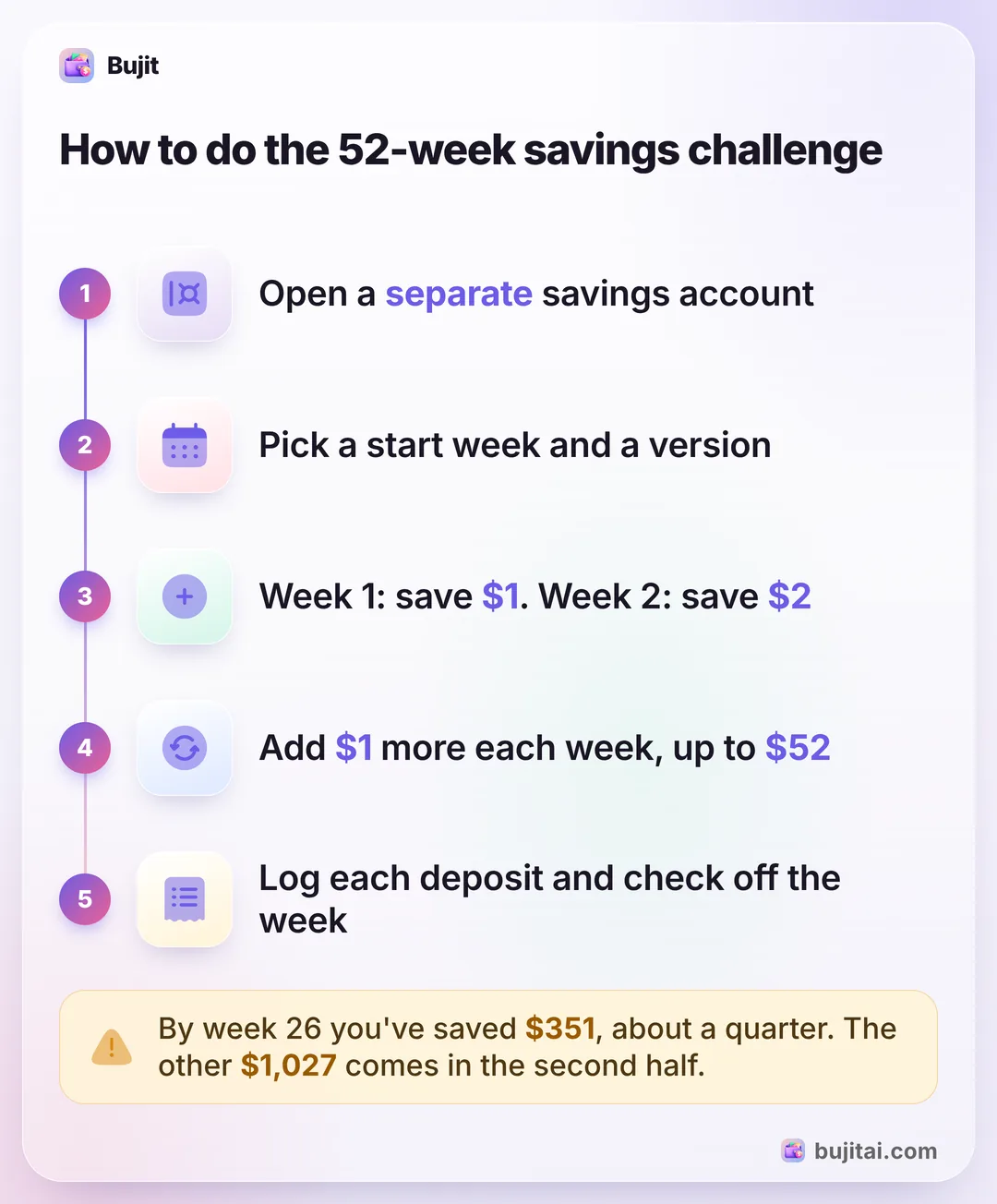
Each week, you save the week's number in dollars: $1 in week 1, $2 in week 2, $3 in week 3, up to $52 in week 52. Fidelity and Experian both put the total at $1,378. You can start any week. Fidelity notes it doesn't have to line up with any time of year, though it works as a New Year's resolution too.
- Open a separate place for the money. Experian's advice is to keep the challenge money apart from your checking account, in a savings account online or at a local bank. Fidelity notes that high-yield savings accounts, which pay more interest, are generally available with FDIC insurance.
- Pick your start week and your version. The classic version rises by $1 a week. If that doesn't fit your pay or your year, pick one of the versions below before you start.
- Write out the chart. Fifty-two boxes, one for each week, with the amount to save and the running total. Stick it on the fridge or keep it on your phone.
- Save on the same day every week. Payday is easiest, because the money hasn't had time to go anywhere else. Move it in your bank's app, or set up an automatic transfer if your amount stays the same.
- Check off the week. Cross off the box once the money has moved. If you miss a week, make both deposits the next week, so the gap doesn't grow.
- Plan ahead for the big weeks. From week 40, the deposits are $40 to $52 a week, about $170 to $200 every four weeks. Decide by late summer where that money will come from.
Experian also suggests doing it with a friend or a group: you're less likely to quit if someone else is saving alongside you.
The 52-week savings chart
Here is the whole year in blocks of four weeks, which is roughly a month. The last column is what you should have saved by the end of each block.
| Save each week | In these 4 weeks | Total saved | |
|---|---|---|---|
| Weeks 1 to 4 | $1, $2, $3, $4 | $10 | $10 |
| Weeks 5 to 8 | $5 to $8 | $26 | $36 |
| Weeks 9 to 12 | $9 to $12 | $42 | $78 |
| Weeks 13 to 16 | $13 to $16 | $58 | $136 |
| Weeks 17 to 20 | $17 to $20 | $74 | $210 |
| Weeks 21 to 24 | $21 to $24 | $90 | $300 |
| Weeks 25 to 28 | $25 to $28 | $106 | $406 |
| Weeks 29 to 32 | $29 to $32 | $122 | $528 |
| Weeks 33 to 36 | $33 to $36 | $138 | $666 |
| Weeks 37 to 40 | $37 to $40 | $154 | $820 |
| Weeks 41 to 44 | $41 to $44 | $170 | $990 |
| Weeks 45 to 48 | $45 to $48 | $186 | $1,176 |
| Weeks 49 to 52 | $49 to $52 | $202 | $1,378 |
The first four weeks need $10 between them; the last four need $202, twenty times as much. By week 26 you've saved $351, about a quarter of the total, and the other $1,027 comes in the second half. That's why the challenge feels easy in spring and hard in the fall.
Versions that fit your pay and your year
The classic chart isn't the only way to reach $1,378. Fidelity and Experian both mention a flat weekly amount, and the backward, flat and payday versions just move the same dollars around.
| First deposit | Last deposit | Total in a year | |
|---|---|---|---|
| Classic: $1 more each week | $1 | $52 | $1,378 |
| Backward: $52 down to $1 | $52 | $1 | $1,378 |
| Flat: the same every week | $26.50 | $26.50 | $1,378 |
| Every payday, two weeks at a time | $3 | $103 | $1,378 |
| Bigger steps: $5 more each week | $5 | $260 | $6,890 |
- Backward puts the hardest weeks first, while you're motivated, and the easiest at the end. Started on Friday, January 1, 2027, the classic version's last five weeks run from November 26 to December 30, the day after Thanksgiving through the holidays, and need $250. Backward, they need $15.
- Flat is the one to automate. Fidelity suggests a $26.50 weekly transfer from checking to savings for the same result, hands-off.
- Every payday suits a biweekly paycheck: on each payday, save two weeks' amounts, $3 for weeks 1 and 2, $7 for weeks 3 and 4, up to $103 for weeks 51 and 52.
- Bigger steps are for when $1,378 isn't the goal you need. Raising it by $5 a week, as Experian suggests for an extra push, ends at $260 in week 52 and $6,890 in all.
What the 52-week challenge doesn't do
- It isn't your whole savings plan. Fidelity calls savings challenges a complement to larger savings guidelines, not a replacement. Its own suggestion is at least 15% of pre-tax income for retirement, including any employer match, and 10% of take-home pay for near-term goals and emergency savings.
- $1,378 is a start on an emergency fund, not the whole of one. Experian points to three to six months of expenses as the usual aim, and the challenge as a strong way to start.
- It doesn't find the money. The chart tells you how much to save each week. In the fall, when the weekly amount passes $40, it has to come out of something else you would have spent.
- Missed weeks add up. Skip weeks 48 and 49, and catching up in week 50 means saving $147 at once.
| Paper chart | Spreadsheet | Bank app | Bujit | |
|---|---|---|---|---|
| Moves the money | With a recurring transfer | No, your bank does | ||
| Shows weeks done and the total | Count the crossed-off boxes | With a formula | Your savings balance | A category's count and total in History |
| Shows where next week's money can come from | If you track spending there too | A list of transactions | Each category's spending this month | |
| Includes cash | As ATM withdrawals | |||
| Needs a bank login | No | No | Yes | No |
How to keep up with the 52-week challenge in Bujit
Bujit, the expense tracker we make, tracks spending and doesn't move money, so the deposits happen in your bank's app. What Bujit adds is a record of each deposit and a view of where the money for the next one can come from, with no bank login and no account.
In Bujit
Get Bujit- Add a category for the challenge. On Home, tap the gear, then Categories, then +, name it something like "52-week challenge" and tap Save.
- Log each week's deposit. After the transfer, tap + at the top right, then Manual Entry, enter the week's amount, type "Week 12" in What was this for?, pick the challenge category and tap Save. Doing the flat $26.50 version? Touch and hold the first deposit in History, tap Make Recurring, set Repeat to Weekly, leave Start Date on that day and tap Save. Bujit adds each week's entry when it comes due, the next time you open the app; it doesn't check that the transfer went through.
- See how far you've got. Open History, choose Custom, set the dates from your start date to today, and tap the challenge category. History shows how many deposits there are and what they add up to: by week 12, that's 12 transactions and $78.
- Find next week's money. Choose Last Month in History and tap a category, such as Food or Entertainment, to see its total. Pick the one that can give up the week's amount.
- Give that category a lower limit. Open Budgets, tap Set a budget on that category's card (if it already has a budget, tap the card instead), enter last month's total minus what the challenge needs that month, and tap Save. Drag Notify me at to a percentage such as 80%, and a banner appears when an expense you add in the app passes it.
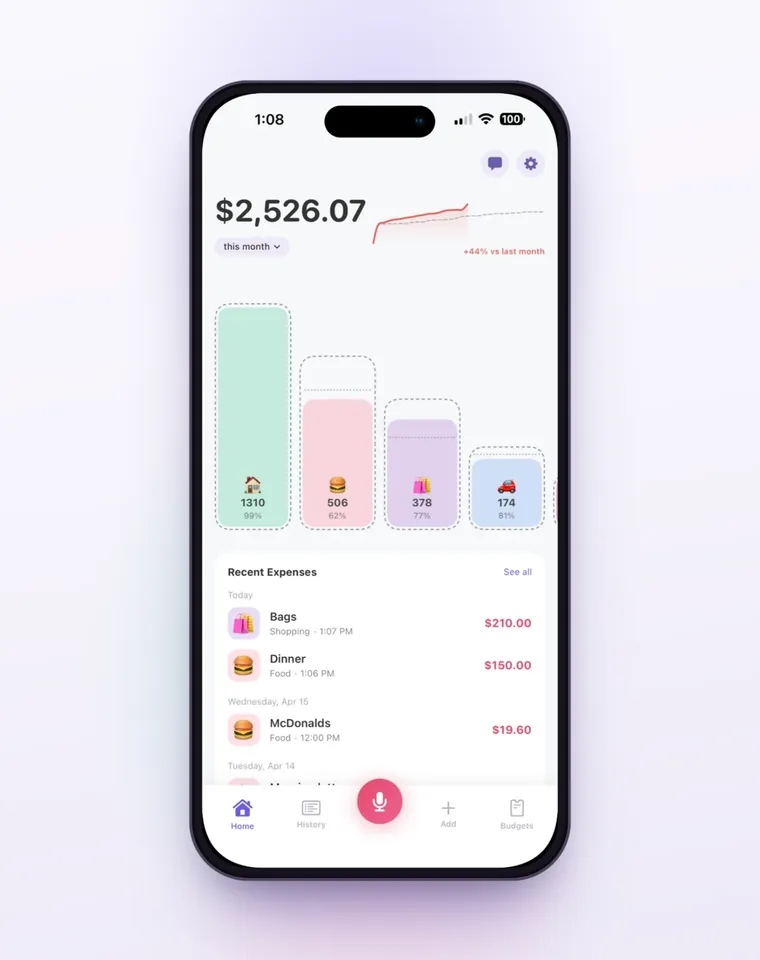
Logged deposits count toward the month's total on Home, like any expense, so the challenge category also shows how much of the month went to savings. A budget card says Approaching limit past 80% and Over budget by the amount once you pass it. Budgets count the calendar month and start again on the 1st, with nothing carried over. On iPhone, a Shortcuts automation can log each Apple Pay purchase when you tap your iPhone to pay; it sorts them into Bujit's six built-in categories, and those taps don't show the budget banner when you pay. Voice entry and receipt scanning are part of Bujit Pro; they send what they need to Google Gemini, and only after you agree. Your expenses are stored on your phone.
Which should you use?
- You've never saved regularly: the classic version, starting at $1 this week.
- You'd rather not think about it: the flat version, with an automatic $26.50 weekly transfer.
- You're paid every two weeks: two weeks' amounts on each payday.
- December is always tight: run the chart backward, so the holidays get the $1 weeks.
- You want to know where each week's money will come from: log your spending in an expense app like Bujit and trim one category by the week's amount.
If the late weeks look out of reach, a short no-spend challenge before the big weeks can free up a month's worth. And when week 52 is done, keep the habit: Experian suggests starting another challenge or saving part of every paycheck automatically, which is paying yourself first.
Questions people ask
What is the 52-week savings challenge?
A year-long savings plan where each week you save the week's number in dollars: $1 in week one, $2 in week two, up to $52 in week 52. Fidelity and Experian both put the total at $1,378. It starts small on purpose, so saving becomes a habit before the amounts get bigger.
How much do you save with the 52-week challenge?
$1,378 in the classic version. Saving $2 more each week instead of $1 doubles it to $2,756, and raising it by $5 a week, one of Experian's ideas, comes to $6,890. Saving a flat $26.50 every week also gives you $1,378.
Can I do the 52-week challenge if I'm paid every two weeks?
Yes. Save two weeks' amounts on each payday: $3 on the first (weeks one and two), $7 on the second, and so on up to $103 on the last (weeks 51 and 52). That's 26 deposits and the same $1,378.
Should I do the 52-week challenge backward?
If December is your tight month, it helps. Started on January 1, 2027, the classic version asks for $250 between November 26 and December 30, right through the holidays. Backward, those five weeks need $15, and the big $52 week comes first, while you're motivated.
Where should I keep the money?
Somewhere separate from your checking account, so it doesn't get spent by accident. Experian suggests a savings account, and a high-yield one if you want interest with easy access. Fidelity notes high-yield savings accounts are generally available with FDIC insurance.
What if I miss a week?
Catch up the next week by making both deposits, or move the missed amount to the end and add a week. The total only stays at $1,378 if every week gets paid in, so missed weeks are worth fixing before they pile up.
Can I track the 52-week challenge in Bujit?
Bujit doesn't move money, so the deposit happens in your bank's app. You can log each deposit in a category of its own, then choose Custom in History from your start date and tap that category to see how many weeks you've paid in and the total so far.
Sources
- The 52-week money challenge (Fidelity) (checked Nov 19, 2026)
- How to Do the 52-Week Money Challenge (Experian) (checked Nov 19, 2026)