Quick answer
To pay yourself first, move part of every paycheck to savings as soon as it arrives, before you pay bills or spend anything. Pick an amount, often 10% to 20% of your pay, and make it automatic with a split direct deposit or a recurring transfer on payday. Then plan the month around what's left.
- The idea
- Savings first, then bills, then spending
- How much
- Often 10% to 20% of your paycheck
- Make it automatic
- Split direct deposit or a payday transfer
- Save first for
- An emergency fund and retirement
On this page
What paying yourself first means
To pay yourself first is to put part of your income into savings before you pay a bill or buy anything. The usual way is the other way around: spend, pay the bills, and save what's left over. Experian points out that once your bills are paid, the rest of your money can practically spend itself, so saving last often means not saving at all.
If that sounds familiar, you're not alone. In the Federal Reserve's survey of U.S. households in 2025, 63% of adults said they would cover a $400 emergency expense with cash or its equivalent, so 37% would not. Paying yourself first gives savings the same priority as rent: it comes out every month, whatever else happens.
How to pay yourself first
These steps follow Experian's guide and the Consumer Financial Protection Bureau's (CFPB) advice on building savings. You need your last pay stub and a few minutes with your bank's app.
- Start from your take-home pay. Use what lands in your account after taxes and deductions. If your employer already takes retirement contributions out of your paycheck, that's paying yourself first too, before you ever see the money.
- Pick an amount you can keep up. Experian suggests 10% to 20% of each paycheck as a goal, and less if money is tight. The CFPB agrees that even a small amount gives you some security, and suggests putting away a specific amount each time you're paid.
- Decide where it goes. Most experts put an emergency fund and retirement first, Experian says. After that, savings for big expenses you can see coming, like a car, a vacation or repairs. If you carry high-interest credit card debt, part of the money can go to paying it down.
- Make it automatic. Ask your employer whether your direct deposit can be split between checking and savings, so part of each paycheck goes straight to savings. If not, set up a recurring transfer from checking to savings on payday.
- Add one-off money when you get it. Tax refunds, bonuses, cash gifts and side income aren't part of your regular month, so they're easier to set aside. Experian suggests saving a percentage of any of them, and the CFPB suggests saving all or part of a tax refund or cash gift.
If you want a rule for the rest of your pay too, splitting take-home pay 50/30/20 gives savings and extra debt payments 20% and splits the rest between needs and wants. And if you've never added up where your money goes, writing down every purchase for a month shows you how much you can realistically set aside.
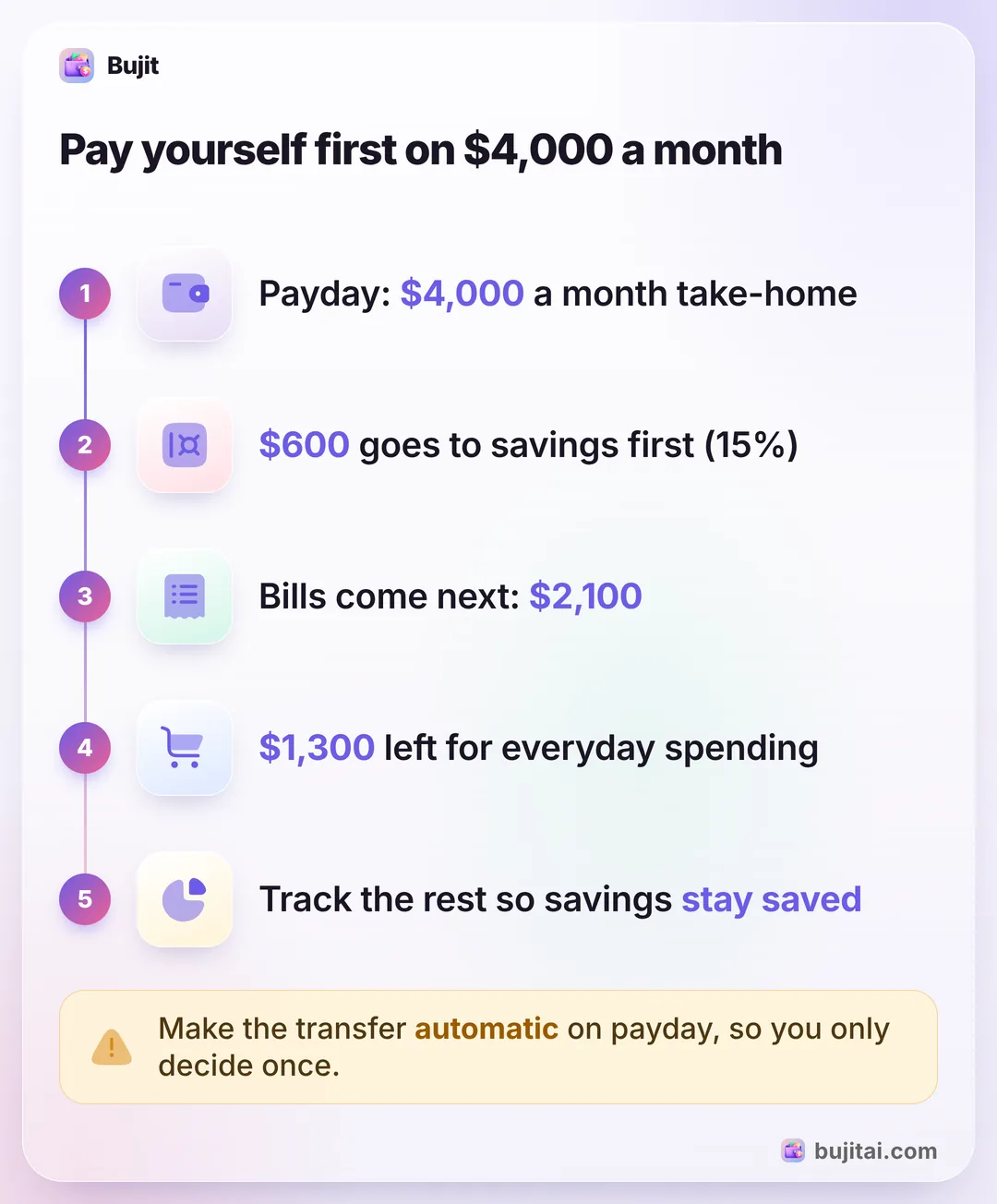
Paying yourself first on $4,000 a month
Here's how it looks with $4,000 of take-home pay a month, paid as two paychecks of $2,000, with made-up numbers. $300 of each paycheck goes to savings by split direct deposit, 15% of the month's pay:
| Each month | When it goes | |
|---|---|---|
| Savings | $600 | Payday, automatically |
| Rent | $1,400 | On its due date |
| Utilities and phone | $200 | On its due date |
| Car payment and insurance | $350 | On its due date |
| Minimum debt payments | $150 | On its due date |
| Groceries | $450 | As you spend |
| Gas | $150 | As you spend |
| Eating out | $200 | As you spend |
| Shopping | $150 | As you spend |
| Fun | $150 | As you spend |
| Everything else | $200 | As you spend |
Savings and bills add up to $2,700, and they take care of themselves. The $1,300 for everyday spending is the part to watch: it has to last until the end of the month, about $300 a week. Run out early and the money comes from savings or a credit card, and paying yourself first quietly stops working.
What paying yourself first doesn't solve
- It doesn't stop overspending. Savings leave on payday, but nothing limits what happens to the rest. If groceries and eating out run over, the gap comes out of savings or goes on a card.
- It doesn't tell you what's left. Your checking balance on the 18th includes rent and bills that haven't gone out yet, so it looks bigger than what you can spend.
- It can cause an overdraft. An automatic transfer that lands before your pay, or after a big bill, can take your account below zero. The CFPB suggests balance alerts or a calendar reminder to check.
- It's harder with irregular pay. The CFPB says automatic transfers help anyone, but particularly people with a consistent income. With pay that changes, you decide each time how much to move, and saving first takes more discipline.
| Notebook | Spreadsheet | Bank app | Bujit | |
|---|---|---|---|---|
| Moves money to savings | With a recurring transfer | No, your bank or employer does | ||
| Shows what's left to spend this month | If you add it up | With formulas | Your balance, before bills still to come | Spent of the Monthly Budget, with a bar |
| Warns before you run short | If you set up color rules | Low-balance alerts, at some banks | A banner when an expense you add passes a category's Notify me at level | |
| Includes cash | As ATM withdrawals | |||
| Needs a bank login | No | No | Yes | No |
How to pay yourself first with Bujit
Bujit, the expense tracker we make, tracks spending, not income or savings, and it doesn't move money. The transfer is set up with your bank or employer. Bujit holds the rest of the month, with no bank login and no account.
In Bujit
Get Bujit- Set up the transfer first. Split your direct deposit or schedule a payday transfer to savings, as in step 4 above.
- Set the Monthly Budget to what's left. Open Budgets, tap Set on the Monthly Budget card, enter your take-home pay minus your savings as the Amount and tap Save. In the example, that's $4,000 minus $600: $3,400.
- Add your bills once. Tap + at the top right, then Manual Entry, enter a bill with Date set to the day it last went out, and tap Save. Then touch and hold it in History, tap Make Recurring, set Repeat to Monthly, leave Start Date on that day and tap Save. Each month, Bujit adds it when it comes due, the next time you open the app, so bills count against the $3,400 too.
- Give your everyday spending limits. Tap Set a budget under a category, enter its Amount and tap Save, then drag Notify me at on its card to a percentage such as 80%. A banner tells you when an expense you add in the app passes it.
- Log as you pay. Tap +, then Manual Entry, enter the amount, what it was for and the category, and tap Save.
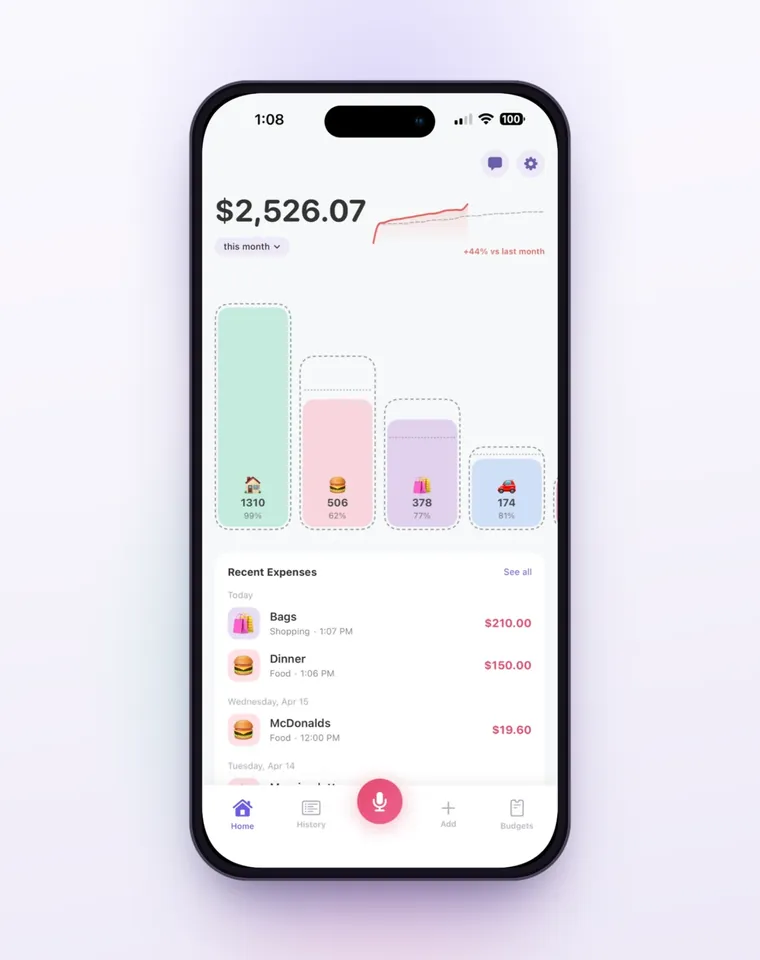
A category's card says Approaching limit past 80% and Over budget by the amount once you pass the limit. Budgets count the calendar month and start again on the 1st, with nothing carried over, so move whatever you didn't spend to savings yourself. On iPhone, a Shortcuts automation can log each Apple Pay purchase when you tap your iPhone to pay; it sorts them into Bujit's six built-in categories, and those taps don't show the budget banner when you pay. Voice entry and receipt scanning are part of Bujit Pro; they send what they need to Google Gemini, and only after you agree. Your expenses are stored on your phone.
Which should you use?
- You get a steady paycheck by direct deposit: a split direct deposit, so your savings never pass through checking.
- Your employer can't split it: a recurring transfer from checking to savings, set for payday.
- Your pay changes from month to month: save a share of each payment as it arrives, and one-off money like tax refunds.
- You keep running short before payday: track the rest of the month in an expense app like Bujit, with the Monthly Budget set to what's left after savings.
Start with an amount that feels a little too small. A transfer you never cancel saves more than a big one you stop in the second month, and once it's routine you can raise it. If you'd rather raise it a little every week, the 52-week savings challenge starts at $1 and adds a dollar each week.
Questions people ask
What does pay yourself first mean?
It means putting part of your income into savings or investments before you pay bills or spend on anything else. Instead of saving whatever is left at the end of the month, which is often nothing, you save at the start and live on the rest.
How much should I pay myself first?
Experian suggests 10% to 20% of each paycheck as a goal, and a smaller amount if money is tight. What matters most is an amount you can keep up month after month. You can raise it later, for example when you pay off a credit card.
What should the money go to first?
An emergency fund and retirement. Experian says most experts put those first, at least until the emergency fund is big enough and retirement saving is on track. It also suggests using part of the money to pay down high-interest credit card debt if you have it.
How do I make paying myself first automatic?
Ask your employer whether you can split your direct deposit between checking and savings, so part of each paycheck goes straight to savings. If you can't, set up a recurring transfer from checking to savings with your bank on payday. The CFPB suggests keeping an eye on your balance so the transfer doesn't cause an overdraft fee.
Can I pay myself first with an irregular income?
Yes, but automatic transfers are harder. The CFPB says they help anyone, but particularly people with a consistent income. With pay that changes, save a share of each payment as it arrives, move a little extra in the weeks you have more, and save all or part of one-off money like a tax refund.
Is paying yourself first the same as the 50/30/20 rule?
No. Paying yourself first is about order: savings come out before anything else. The 50/30/20 rule is about shares: half of take-home pay for needs, 30% for wants and 20% for savings and debt. They work well together, with the 20% as the amount you pay yourself first.
Can I pay myself first with Bujit?
Bujit doesn't move money or track savings, so the transfer is set up with your bank or employer. Bujit holds the rest: set the Monthly Budget to your take-home pay minus what you save, log purchases as you pay, and you see how much of what's left is gone.
Sources
- What Does It Mean to Pay Yourself First? (Experian) (checked Nov 16, 2026)
- An essential guide to building an emergency fund (Consumer Financial Protection Bureau) (checked Nov 16, 2026)
- Federal Reserve Board issues Economic Well-Being of U.S. Households in 2025 report (Federal Reserve) (checked Nov 16, 2026)