Quick answer
To stick to a budget, make it easy to keep up: log each purchase when you pay, check what's left in every category once a week, and give irregular bills and a little fun money their own lines. When you overspend in one category, move money from another and keep going instead of starting over.
- Log
- Each purchase, when you pay
- Check
- Once a week, same day
- Plan for
- Irregular bills and fun money
- After a bad week
- Move money, don't start over
On this page
How to stick to a budget, step by step
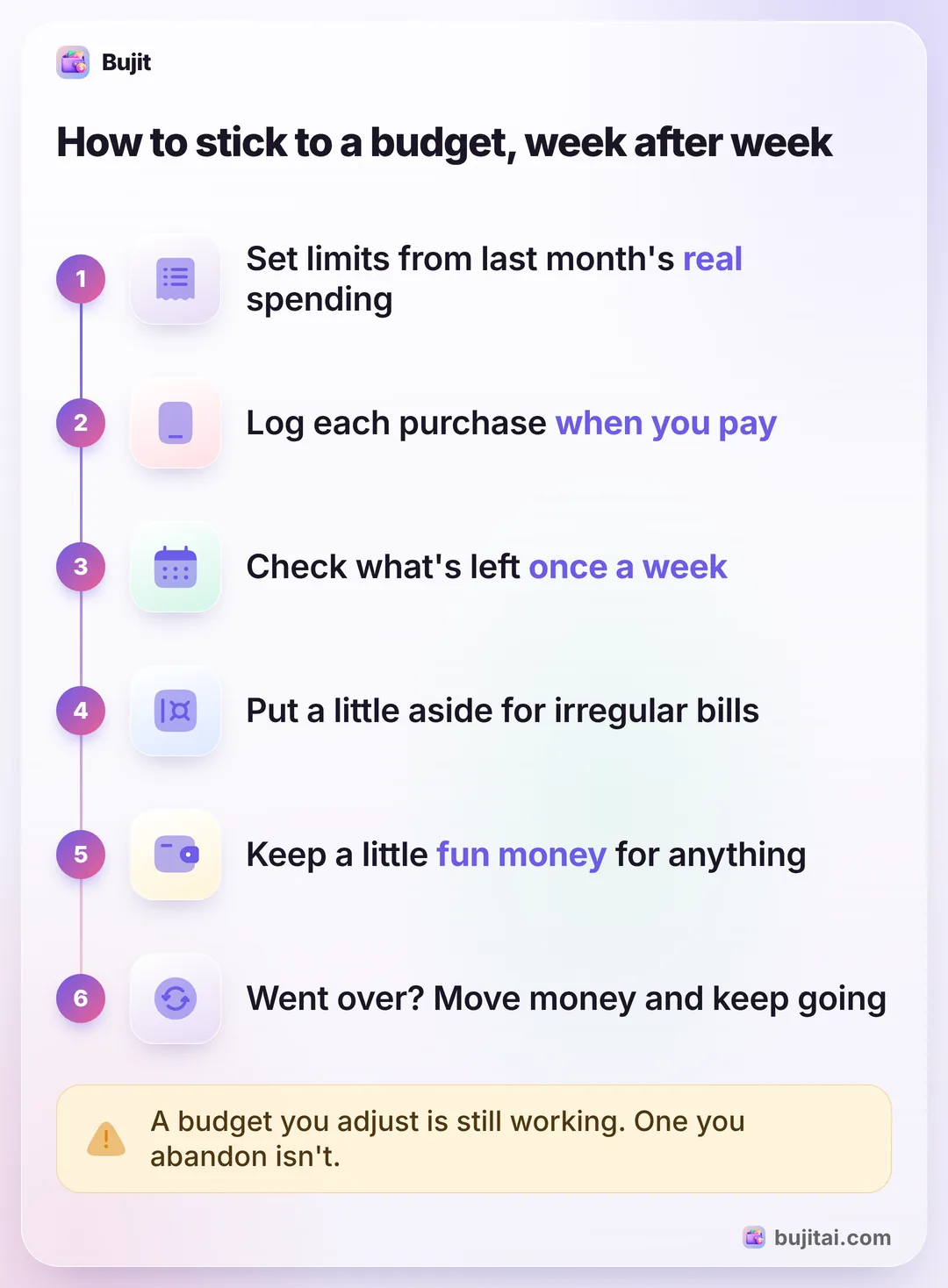
Knowing how to stick to a budget matters as much as how you build it. A budget is a plan for the month, and it only works if you keep checking real spending against it. These six habits do that with a notebook, a spreadsheet or an app.
- Set limits from real spending. A limit you picked because it sounded right breaks the first week life costs more. Use last month's statements and receipts, and trim the categories you want to bring down a little at a time. Setting up a first budget walks through it, and the 50/30/20 rule on a real paycheck is a quick check on the overall split.
- Log each purchase when you pay. A daily log catches the small things, like buying lunch instead of bringing it, that add up over a month. Write it down at the register or right after, before it slips your mind.
- Check what's left once a week. Pick a day, such as Sunday, and compare what's left in each category with the weeks left in the month. Ten minutes once a week beats an hour of catching up at the end of the month.
- Give irregular bills a line of their own. Car registration, a yearly subscription, gifts: add up a year of them, divide by 12 and set that much aside each month. Then the month they land doesn't break your food or shopping limit.
- Keep a little money you can spend on anything. A budget with no room for fun tends to get dropped. A small fixed amount for treats, and a reward when you hit a goal, makes the rest easier to keep.
- After a bad week, move money instead of starting over. Take what you overspent from a category with room this month, so the total stays the same. If a category goes over two months in a row, change its limit.
The Consumer Financial Protection Bureau adds two more: if you know you're prone to impulse spending, make a doable plan to limit it, and lean on family or friends you trust to do a budget with you or listen when you're struggling. Cutting back where it's hardest is easier with a plan for impulse buys.
What to do the week you go over
Going over in one category isn't the budget failing. It's the budget doing its job: showing you early, while there's still time to change something.
- Move money between categories. Over on food by $40, under on entertainment by $60? Take $40 from entertainment. The month's total stays where you planned it.
- Find the cause before changing the limit. A one-off, like a birthday dinner, needs nothing more. The same overspend every month means the limit is too low for your life.
- Check when the bills land. If you run short at the end of every month, your paydays and due dates may not line up. Asking a biller to move a due date may fix it without changing a single limit.
- Keep logging. The week you go over is the week it's tempting to stop writing things down, and the one where the numbers matter most.
If several categories went over at once and the month feels out of reach, a short reset can help: a week or a month of buying only essentials frees up money and shows you which extras you really missed.
If your categories themselves don't fit, a shorter list of budget categories can make the weekly check quicker.
What a budget on paper doesn't do
A notebook or a spreadsheet holds the plan well, but it only knows what you've written down, and it can't tell you a category is nearly spent while you're standing in the store.
| Notebook | Spreadsheet | Bank app | Bujit | |
|---|---|---|---|---|
| Shows what's left in each category | If you work it out | With formulas | Some banks | Spent of each limit, with a bar |
| Warns you when a category is nearly spent | Color rules, if you set them up | Some banks | A banner when you add an expense in the app | |
| Includes cash | As ATM withdrawals | |||
| Logs a purchase without typing | That bank's accounts only | Apple Pay iPhone taps, via a Shortcuts automation | ||
| Needs a bank login | No | No | Yes | No |
How to stick to a budget in Bujit
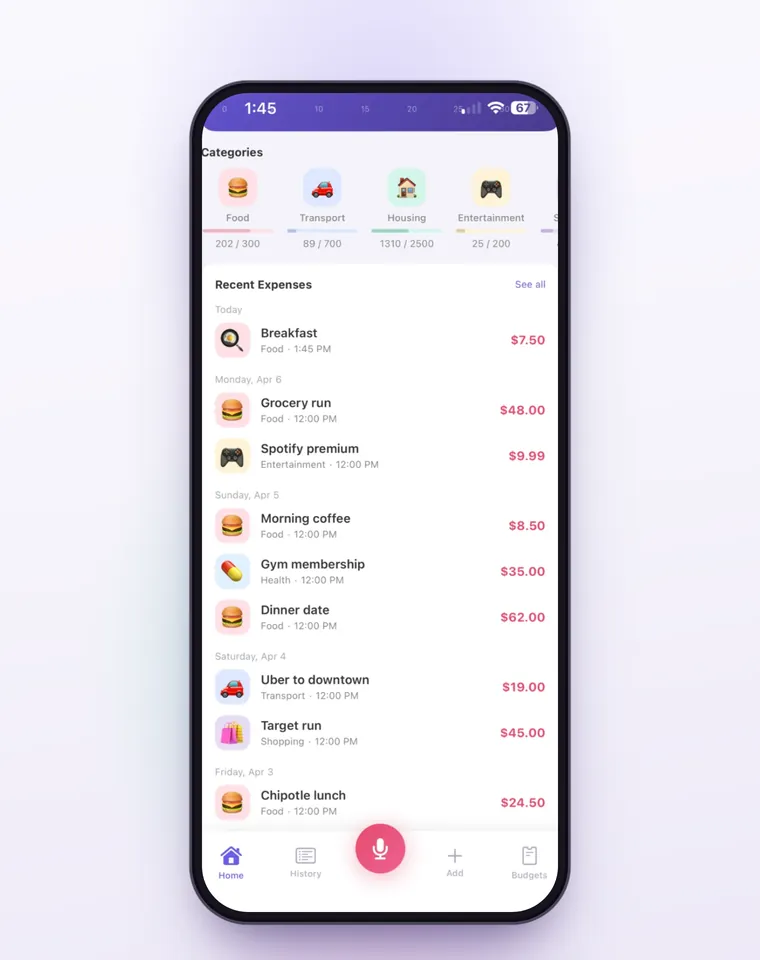
Bujit, the expense tracker we make, has no bank login and no account. You log what you spend, and each budget shows what's spent against its limit.
In Bujit
Get Bujit- Give each category a limit. Open Budgets, tap Set a budget under a category, enter the Amount and tap Save. For one number for the whole month, tap Set on the Monthly Budget card.
- Choose when to hear about it. Once a budget is set, its card shows Notify me at: drag it to the percentage you want, such as 80%. A banner tells you when an expense you add in the app passes it.
- Log when you pay. Tap + at the top right, then Manual Entry, enter the amount, what it was for and the category, and tap Save. Or, with Bujit Pro, tap the microphone and say it.
- Do the weekly check in Budgets. Each card shows what's spent of its limit. Past 80% it says Approaching limit, and once you're over it shows Over budget by and the amount.
- Let regular bills add themselves. Long-press a bill on Home or History, tap Make Recurring, choose Monthly under Repeat and tap Save. Bujit adds it when it comes due, the next time you open the app.
Voice entry and receipt scanning are part of Bujit Pro. They send what they need to Google Gemini, and only after you agree. On iPhone, a Shortcuts automation can log each Apple Pay purchase when you tap your iPhone to pay, sorted into a category from the merchant's name. Those taps don't show the budget banner when you pay, so open Budgets for the weekly check too. Your expenses are stored on your phone.
Which should you use?
- You like writing things down and you'll do the math: a notebook, with the weekly check on the same day each week.
- You want formulas and a view of the whole year: a spreadsheet on your phone, so you can add each purchase when you pay.
- You pay for almost everything with one card: your bank app may show enough, as long as you look at it every week.
- You use cash and cards and want each category's number without adding it up: an expense app like Bujit, with a limit on each category and a banner before you reach it when you add an expense in the app.
Whichever you use, judge it after a full month, not after one bad week. The second month is usually the one where the limits fit.
Questions people ask
How do I stick to a budget when I keep overspending?
Find out where it happens first. Log every purchase for two weeks and look at which category runs over. Then raise that limit to something real and take the money from a category with room, or give the problem spending a smaller weekly amount, so you hit a limit sooner.
What should I do when I go over budget?
Move money from a category that has room this month, so the total stays the same, and keep going. If the same category goes over two months in a row, the limit was too low: raise it and lower another one. Going over once isn't a reason to start over.
How often should I check my budget?
Once a week, on the same day. Compare what's left in each category with the weeks left in the month. A weekly check gives you time to change course, while a check at the end of the month only tells you what already happened.
Why can't I stick to a budget?
Usually because the limits were guesses, a bill that doesn't come every month broke one category, the logging slipped, or the budget left no room for anything fun. Each has a fix: limits from real spending, a line for irregular bills, logging when you pay and a small amount you can spend on anything.
How do I stick to a budget with an irregular income?
If you don't get paid the same every month, the FTC suggests adding up last year's income and dividing by 12 to estimate a month. In a better month, put the extra toward savings or next month's bills instead of raising your limits.
Can Bujit warn me before I go over my budget?
Yes, for expenses you add in the app. Set a budget for a category, then drag Notify me at on its card to the percentage you want, such as 80%. A banner tells you when an expense you add in Bujit passes it. Apple Pay taps logged by Shortcuts don't show the banner when you pay.
Sources
- Budgeting: How to create a budget and stick with it (Consumer Financial Protection Bureau, archived) (checked Nov 5, 2026)
- Making a Budget (consumer.gov, Federal Trade Commission) (checked Nov 5, 2026)