Quick answer
Microsoft makes free budget templates for Excel. On Windows, click File, then New, type budget in the search box and pick one; on a Mac, click File, then New from Template. Excel for the web is free. To build your own, list categories with a planned amount, log purchases on a second sheet and total each category with SUMIF.
- Windows
- File, New, search for budget
- Mac
- File, New from Template
- Key formula
- SUMIF, one per category
- Free option
- Excel for the web
On this page
How to open Microsoft's budget template in Excel
Microsoft publishes free budget templates for Excel, with names like Personal monthly budget, Family budget and Simple personal budget. Each opens as a new workbook with the formulas already in place, so you replace the sample numbers with your own. You don't need the desktop app, either: Microsoft says Excel for the web is free for anyone to use online, and you sign in with a free Microsoft account. If you don't know your numbers yet, start with a monthly budget built from your bills and pay, then come back to fill in the template.
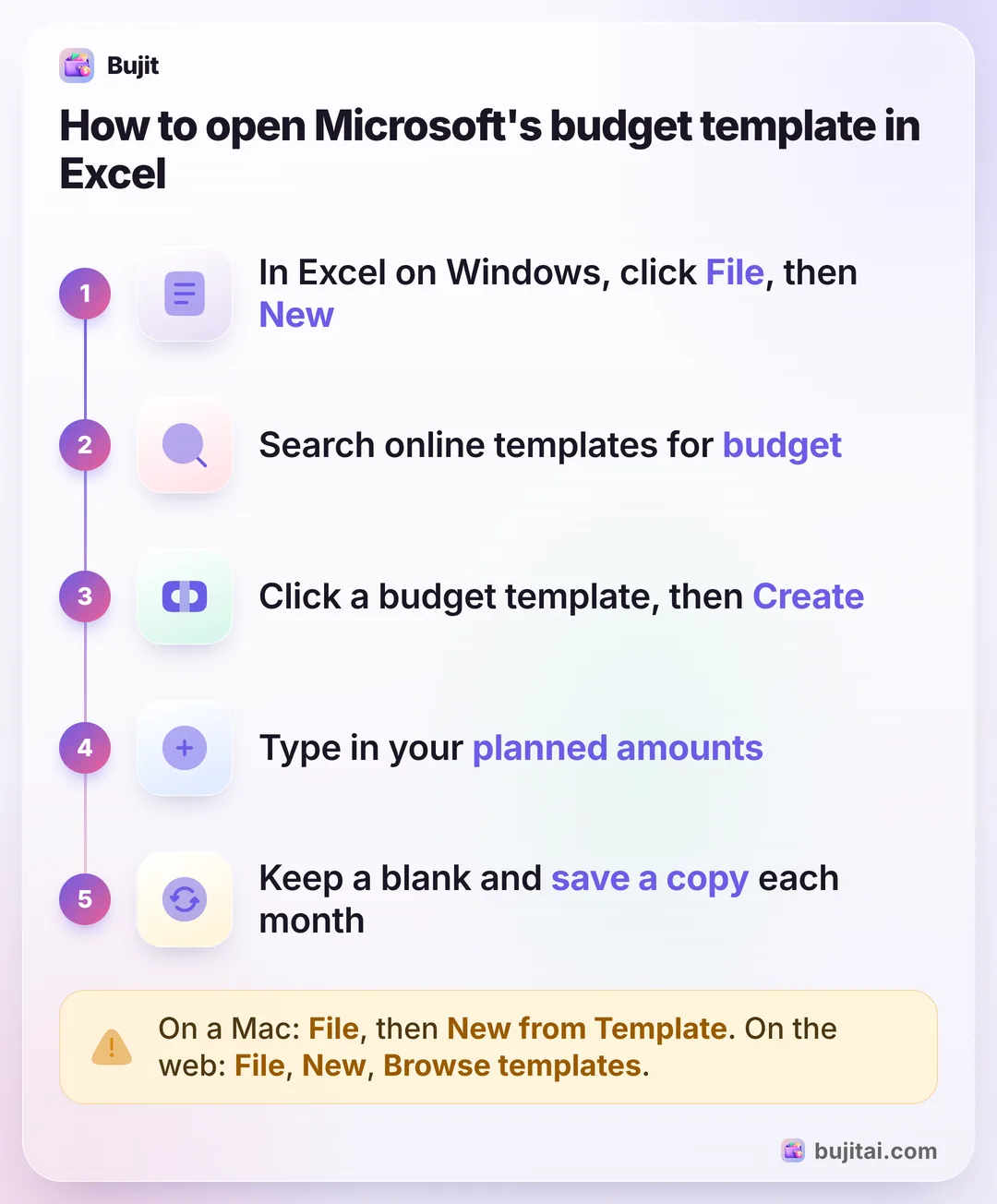
- Open the template list. In Excel on Windows, click File, then New. On a Mac, click File, then New from Template. In Excel for the web, click File, then New, then Browse templates.
- Search for budget. On Windows, select Search for online templates, type budget and select the magnifying glass. On a Mac, type budget in the Search All Templates box on the right. On the web, select Explore all templates below the pictures and type budget in the Search Excel templates box.
- Pick a template and open it. On Windows or a Mac, click Create; on the web, select the template. A new workbook opens with the template's sheets and formulas, ready to change.
- Make it yours. Replace the sample categories and planned amounts with yours and delete the sample spending. Leave the cells that hold formulas alone, so the totals keep working.
- Save it as your blank. Save it under a name like Budget blank. At the start of each month, open it, click File, then Save As or Save a Copy, and name the copy after the month before you type anything into it.
Prefer a browser? Microsoft also lists its budget templates on its Create site, where you can open one straight into Excel for the web.
How to build your own budget template in Excel
A workbook you build yourself has nothing in it you didn't put there, which makes it easier to fix when a number looks wrong. You need two sheets: Budget for the plan and Transactions for every purchase.
- Make the Budget sheet. Rename the first sheet Budget. In row 1, type Category, Planned, Spent and Left. From row 2 down, put one category per row in column A and the amount you plan to spend on it in column B.
- Make the Transactions sheet. Add a second sheet and name it Transactions. Type the headings Date, Description, Category and Amount in row 1, so categories fall in column C and amounts in column D.
- Add a category drop-down list. On Transactions, select the Category cells from C2 down. Click Data, then Data Validation. On the Settings tab, under Allow, choose List. Click in the Source box, select your category names on the Budget sheet (A2 down, without the Category header), make sure In-cell dropdown is checked and click OK. Every purchase now gets a category spelled exactly as in your plan.
- Total each category with SUMIF. On Budget, in C2, type
=SUMIF(Transactions!C:C, A2, Transactions!D:D)and fill it down. It adds every purchase whose category matches the name in column A. In D2, type=B2-C2and fill it down to see what's left. - Make overspending stand out. Select the Left column. On the Home tab, click Conditional Formatting, then Highlight Cells Rules, then Less Than. Type 0, keep the Light Red Fill with Dark Red Text format and click OK. Any category that goes over turns red.
Here's the Budget sheet partway through a month, with made-up numbers:
| Planned | Spent | Left | |
|---|---|---|---|
| Rent | $1,400 | $1,400 | $0 |
| Groceries | $450 | $238 | $212 |
| Gas and transit | $300 | $142 | $158 |
| Eating out | $200 | $231 | -$31, in red |
| Subscriptions | $60 | $60 | $0 |
| Fun | $120 | $75 | $45 |
If you're unsure where a purchase belongs, picking budget categories that match how you spend makes the drop-down list shorter and easier to use.
Excel or Google Sheets?
The two do the same job for a personal budget. The same SUMIF formula works in both, and both have free budget templates from their makers. Excel for the web and Google Sheets are both free with an account, while the Excel desktop app is paid, for example as part of a Microsoft 365 plan. If your files already live in Google Drive, follow the same budget template in Google Sheets instead; if your work computer already has Excel, stay here.
Where an Excel budget falls short
- It counts only what you type. A coffee you forget to add never reaches the Spent column, and nothing tells you it's missing.
- It lives on a big screen. Excel is at its best on a laptop. On a phone, finding the next empty row and typing into four small cells takes long enough that most people put it off until later.
- Red appears after the fact. Conditional formatting colors a cell once you've already gone over, and only when you open the workbook.
- Cash disappears. Card purchases are at least on a statement you can copy from. Cash leaves no trace unless you write it down on the spot.
| Your own Excel template | Bujit | |
|---|---|---|
| Plans income and savings | Any rows you add | No, spending only |
| Totals each category | With SUMIF | Spent of each limit, with a bar |
| Adding a purchase from your phone | A new row with four cells | Manual Entry, or a Shortcuts automation for Apple Pay taps on iPhone |
| Warns before a category runs out | No, a cell turns red once it's over | A banner when you add an expense in the app |
| Needs an account | A Microsoft account for the web version | No account |
| Needs a bank login | No | No |
How to use Bujit next to your Excel budget
Bujit, the expense tracker we make, doesn't connect to Excel. It can work beside your workbook, though: the plan stays in Excel, and Bujit does the logging on your phone while you're out. No bank login, no account.
In Bujit
Get Bujit- Keep the plan in Excel. Your planned amounts stay in the workbook, along with income and savings if you've added rows for them.
- Set the same limits in Bujit. Open Budgets, tap Set on the Monthly Budget card (or Edit total budget if it already has one), enter the total of your workbook's spending categories as the Amount and tap Save. Then tap Set a budget under each category, enter its planned amount and tap Save. To add a category your workbook has and Bujit doesn't, tap the gear on Home, then Categories, then +.
- Pick when you hear about it. Drag Notify me at on a category's card to a percentage, such as 80%. A banner appears when an expense you add in the app takes the category past it.
- Log as you pay. Tap + at the top right, then Manual Entry, enter the amount, what it was for and the category, and tap Save.
- Update the workbook once a month. On the 1st, open History, tap This Month and choose Last Month, then tap a category to see its total. On last month's Transactions sheet, add one row per category with that total, and SUMIF fills in the Spent column.
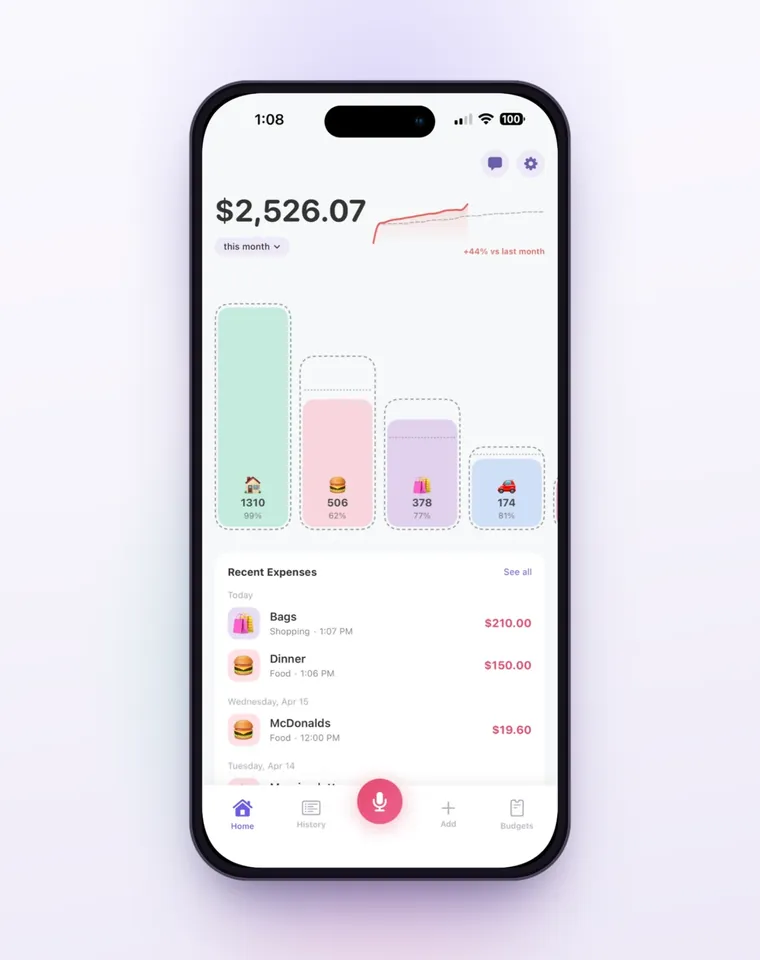
Bujit's budgets follow the calendar month and start fresh on the 1st, with nothing carried over, just like a new copy of your workbook. A category's card says Approaching limit past 80% and Over budget by the amount once you pass it. On iPhone, a Shortcuts automation can log each Apple Pay purchase when you tap your iPhone to pay; it sorts them into Bujit's six built-in categories, so if your workbook uses other names, touch and hold a tap in History, tap Edit and move it before you copy the totals. Those taps don't show the budget banner when you pay. Voice entry and receipt scanning are part of Bujit Pro; they send what they need to Google Gemini, and only after you agree. Your expenses are stored on your phone.
Which should you use?
- You want a budget in Excel today: one of Microsoft's free templates from File, then New, with your numbers in it.
- You want your own categories and formulas: a workbook with a Budget sheet, a Transactions sheet and SUMIF.
- You don't have the Excel app: the same template in Excel for the web, free with a Microsoft account.
- You'd rather log purchases on your phone as you pay: keep the plan in Excel, log in an expense app like Bujit and copy the totals across once a month.
Whichever you choose, put a time in your calendar to update it, such as Sunday evening. A budget nobody fills in is just a list of good intentions.
Questions people ask
Does Excel have a budget template?
Yes. Microsoft makes free budget templates for Excel, such as Personal monthly budget, Family budget and Simple personal budget. On Windows, click File, then New, select Search for online templates, type budget and click a template, then Create. On a Mac, click File, then New from Template, and search for budget.
Is there a free budget template for Excel?
Many of Microsoft's budget templates are free, such as Personal monthly budget and Family budget, though Microsoft also offers some premium ones. You also don't need to buy Excel to use one: Microsoft says Excel for the web is free for anyone to use online, with a free Microsoft account. In Excel for the web, click File, then New, then Browse templates.
How do I make my own budget template in Excel?
Use two sheets in one workbook. On the first, list your categories with a planned amount for each. On the second, log purchases with a date, a description, a category and an amount. Give the category column a drop-down list with Data Validation, then total each category on the first sheet with SUMIF.
What formula adds up a budget category in Excel?
SUMIF. With purchases on a sheet named Transactions, categories in column C and amounts in column D, =SUMIF(Transactions!C:C, A2, Transactions!D:D) adds up every purchase whose category matches the name in cell A2. Copy it down, one row per category.
How do I add a category drop-down list in Excel?
Select the cells in the Category column, click Data, then Data Validation. On the Settings tab, under Allow, choose List. Click in the Source box, select your category names on the other sheet and click OK. Each cell now has an arrow that opens your list.
How do I reuse my Excel budget template next month?
Keep a blank copy. Once the workbook has your categories and planned amounts but no spending, save it under a name like Budget blank. At the start of each month, open it, click File, then Save As or Save a Copy, and name the copy after the month, so last month's purchases stay in last month's file.
Does Bujit work with Excel?
Not directly: Bujit doesn't connect to Excel and has no export. You can keep the plan in your workbook and log purchases in Bujit as you pay, then type each category's monthly total from Bujit's History into the workbook at the end of the month.
Sources
- Free budget templates (Microsoft Create) (checked Nov 18, 2026)
- Create a calendar by using a template, the File and New steps for any template (Microsoft Support) (checked Nov 18, 2026)
- Manage your household budget in Excel (Microsoft Support) (checked Nov 18, 2026)
- SUMIF function (Microsoft Support) (checked Nov 18, 2026)
- Apply data validation to cells (Microsoft Support) (checked Nov 18, 2026)
- Use conditional formatting to highlight information in Excel (Microsoft Support) (checked Nov 18, 2026)
- Microsoft Excel, plans and the free web version (Microsoft) (checked Nov 18, 2026)