Quick answer
To budget a paycheck, start from your take-home pay and list the bills due before your next payday. Set those aside, take out savings, and divide what's left by the weeks until you're paid again. If you're paid every two weeks, even out the bills so one paycheck doesn't carry rent alone.
- Start from
- Take-home pay on your pay stub
- Each paycheck covers
- Bills due before the next payday
- Paid every two weeks
- 26 paychecks, so two months have three
- Track
- What you've spent since payday
On this page
Why budget by paycheck
A monthly budget can add up on paper and still fail on the 28th. The Consumer Financial Protection Bureau (CFPB) puts it simply: if you can't make ends meet at the end of the month, the timing of your income and expenses may be off. Rent, a car payment and a phone bill don't care that your next paycheck is three days away.
Budgeting by paycheck fixes the timing. Each paycheck gets a short list of bills, the ones due before the next payday, plus savings and spending money for the days in between. It matters most if you're paid every week or every two weeks, because those paydays drift through the month instead of landing on the same dates.
How to budget a paycheck
These steps draw on PNC's guide to budgeting your first paycheck, the CFPB's bill calendar and the Federal Trade Commission's (FTC) budget basics at consumer.gov. You need your last pay stub and a list of your bills.
- Start from your take-home pay. Your pay stub shows taxes, Social Security, Medicare and other deductions coming out of your gross pay. What's left, your net or take-home pay, is what you budget. If you're paid by the hour, PNC suggests planning on the lowest paycheck you expect. However you're paid, it suggests leaving bonuses, overtime and side-gig money out of the plan.
- Write down your paydays. Paid every two weeks, you get 26 paychecks in most years, and the dates creep earlier in the month as the year goes on. Mark the next few on a calendar. If you're paid twice a month on fixed dates, like the 1st and the 15th, the dates stay put.
- Make a bill calendar. The CFPB's version takes four steps: gather your monthly bills; write down what each is for, the amount and the due date; put the calendar where you'll check it every week; and use your budget as a guide. Late payments usually mean a fee and can hurt your credit history.
- Give each bill to the paycheck before it. Go through the calendar and assign every bill to the last paycheck that arrives before its due date. Rent due on the 1st goes to the paycheck before the 1st, not the one after.
- Set savings aside like a bill. PNC suggests treating savings as a bill and adding it to your fixed expenses. The 50/30/20 rule puts 20% of take-home pay toward savings and debt; if that's out of reach, PNC says even $25 or $50 a pay period may add up over time.
- Split what's left by week. Whatever remains is your spending money for groceries, gas, eating out and everything else until the next payday. Divide it by the number of weeks, two if you're paid every two weeks, and that's your weekly limit.
Then use it. The FTC suggests writing down what you spend each day and checking at the end of the month whether you spent what you planned. If you'd rather plan the month as a whole first, a full monthly budget covers income and every category, and a 50/30/20 split of each paycheck gives you shares to aim for.
A $1,850 paycheck, budgeted
Here's an example with made-up numbers: $1,850 of take-home pay every other Friday. In March 2027, those Fridays fall on March 5 and March 19, and the next one after that is April 2. These are the bills, and the paycheck each one goes to:
| Amount | Due | Paid from | |
|---|---|---|---|
| Internet | $60 | March 7 | March 5 paycheck |
| Electric | $90 | March 10 | March 5 paycheck |
| Car payment | $310 | March 15 | March 5 paycheck |
| Streaming | $25 | March 18 | March 5 paycheck |
| Car insurance | $120 | March 20 | March 19 paycheck |
| Phone | $65 | March 22 | March 19 paycheck |
| Student loan | $210 | March 25 | March 19 paycheck |
| Rent | $1,300 | April 1 | March 19 paycheck |
The bills come to $2,180 a month, but they don't split evenly. The March 5 paycheck owes $485 and the March 19 paycheck owes $1,695, because rent is due before April 2. After $100 to savings from each, the first paycheck leaves $1,265 to spend and the second only $55. Spend freely after the 5th and the two weeks after the 19th fall apart.
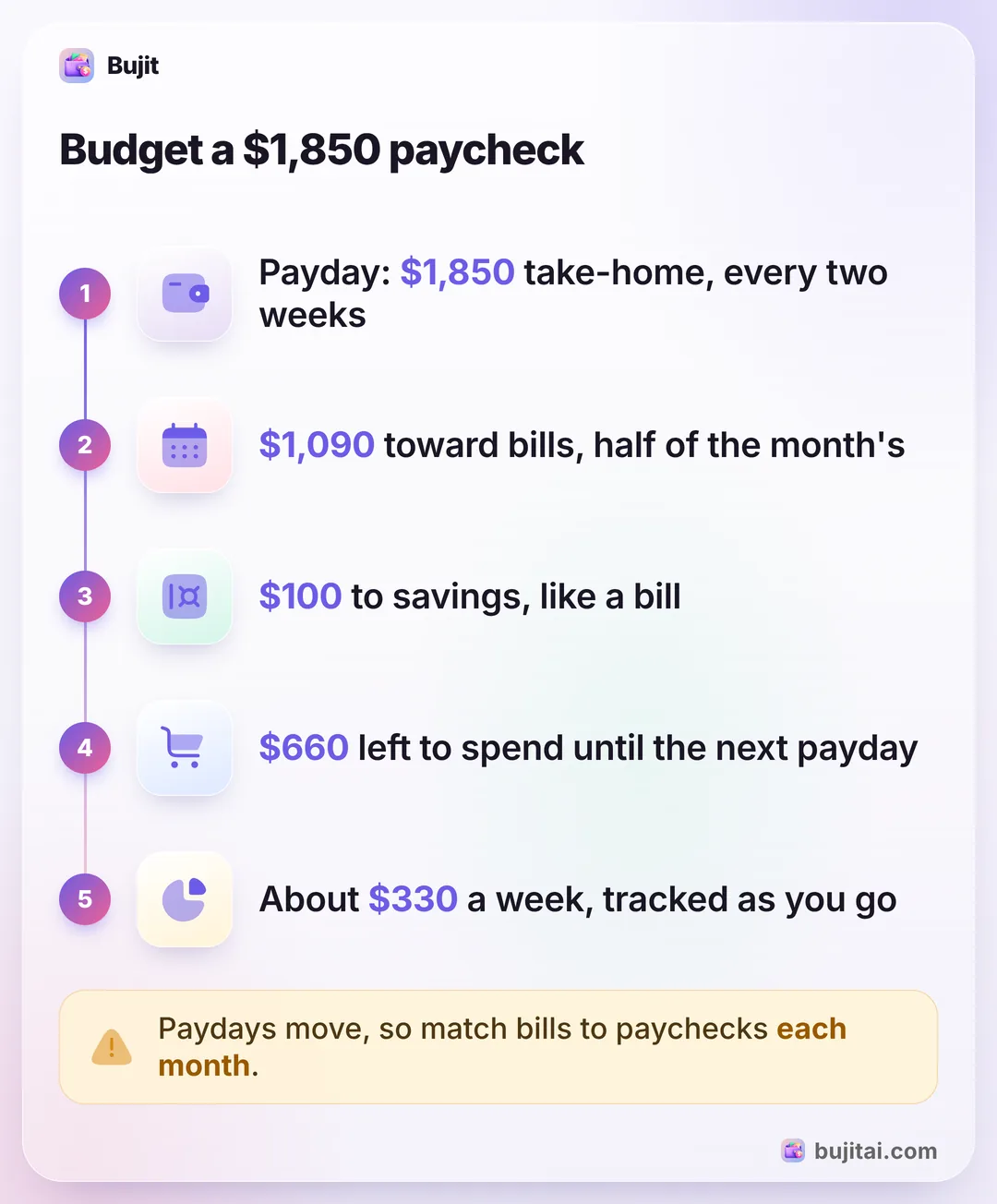
The fix is to even it out: each paycheck puts the same $1,090 toward bills, half of the month's $2,180. The March 5 paycheck pays its $485 and keeps $605 in checking for rent:
| March 5 paycheck | March 19 paycheck | |
|---|---|---|
| Take-home pay | $1,850 | $1,850 |
| Bills due before the next payday | −$485 | −$1,695 |
| Moved to the next paycheck for rent | −$605 | +$605 |
| Savings | −$100 | −$100 |
| Left to spend for two weeks | $660 | $660 |
| Per week, about | $330 | $330 |
Now both paychecks leave $660 for two weeks, about $330 a week for groceries, gas and everything else. The match changes a little every month as the paydays move, so redo it when you plan the month: in May 2027, the paydays are May 14 and May 28, so the May 28 paycheck also pays June's internet and electric.
When a month has a third paycheck
Paid every two weeks, two months a year usually bring a third paycheck. In 2027, with paydays like these, it's April (2, 16 and 30) and October (1, 15 and 29). If you want to be more conservative, PNC suggests budgeting on two paychecks a month and treating any third as extra.
Extra doesn't mean all of it is free. In April, the paychecks of the 2nd and the 16th still put $1,090 each toward bills. April's bills come to $880, so $1,300 is left for May's rent. The April 30 paycheck still has to carry you for two weeks, $660, plus $100 for savings, and the next payday is May 14, so it also pays May's internet and electric, $150. That leaves $940 to use on purpose.
PNC suggests putting extra money toward savings or paying down debt, and warns that irregular costs like car repairs, gifts and travel may throw a budget off track if you haven't set money aside. Paid weekly, the same thing happens with a fifth paycheck, in four or five months a year.
What a paycheck budget doesn't solve
- The spending money still has to last. Bills are on the calendar, but nothing stops $660 from going in the first five days. That's the part to track.
- Your balance looks bigger than it is. Money held back for rent sits in your checking account next to your spending money. Checking the balance on the 12th tells you nothing about what's free to spend.
- Irregular costs still come. A paycheck plan covers bills that repeat. Car repairs, gifts and travel need a little set aside each month, PNC suggests.
- The first month can be tight. If rent is due before you've held anything back, you may need to skip a want or two, or use a third paycheck to get a paycheck ahead.
| Notebook | Spreadsheet | Bank app | Bujit | |
|---|---|---|---|---|
| Shows bills by due date | As a bill calendar | With a date column | Scheduled payments, at some banks | No, keep a bill calendar |
| Shows what you've spent since payday | If you add it up | With formulas | Your transactions, with bills mixed in | History with a Custom range |
| Warns before you run short | If you set up color rules | Low-balance alerts, at some banks | A banner when an expense you add passes a category's Notify me at level | |
| Includes cash | As ATM withdrawals | |||
| Needs a bank login | No | No | Yes | No |
How to budget each paycheck with Bujit
Bujit, the expense tracker we make, tracks spending, not income or bill due dates, and it doesn't move money. Keep the bills on your calendar and let Bujit count the spending money, with no bank login and no account. Its budgets follow the calendar month, not your pay schedule, so you set them for a month and check the paycheck in History.
In Bujit
Get Bujit- Plan the bills first. Match bills to paychecks and set savings aside, as in the steps above. Bujit only needs to count the spending money, so you don't need to log the bills.
- Set the Monthly Budget to a month of spending money. Open Budgets, tap Set on the Monthly Budget card, enter the Amount and tap Save. At $330 a week, that's $330 × 52 weeks ÷ 12 months: about $1,430.
- Give your everyday categories limits. Tap Set a budget under a category such as Food or Transport, enter its Amount and tap Save, then drag Notify me at on its card to a percentage such as 80%. A banner tells you when an expense you add in the app passes it.
- Log as you pay. Tap + at the top right, then Manual Entry, enter the amount, what it was for and the category, and tap Save.
- Check what you've spent since payday. Open History, choose Custom from the range menu, set the first date to your last payday and the second to today. The row above the list shows how many transactions there were and their total, to hold against your $660. This Week shows the current week, to hold against $330.

A category's card says Approaching limit past 80% and Over budget by the amount once you pass the limit. Budgets count the calendar month and start again on the 1st, with nothing carried over, so a paycheck that spans two months shows up in both. On iPhone, a Shortcuts automation can log each Apple Pay purchase when you tap your iPhone to pay; it sorts them into Bujit's six built-in categories, and those taps don't show the budget banner when you pay. Voice entry and receipt scanning are part of Bujit Pro; they send what they need to Google Gemini, and only after you agree. Your expenses are stored on your phone.
Which should you use?
- You're paid twice a month on fixed dates: one bill calendar that stays the same every month, with the month's bills evened out so each paycheck covers half.
- You're paid every two weeks: match bills to paychecks each month, even out the one with rent, and plan a third paycheck on purpose.
- Your hours change: plan on your lowest expected paycheck and treat anything above it as extra.
- You keep running short before payday: track what you've spent since payday in an expense app like Bujit, with limits on the categories that run over.
Start with the next two paychecks, not the whole year. Once rent has a paycheck and the spending money has a weekly number, paying yourself first is one transfer on payday.
Questions people ask
How do I budget a biweekly paycheck?
Write down your paydays and your bills' due dates, then give each bill to the last paycheck before it's due. One paycheck usually ends up with rent, so the other holds back part of its money for it. Take out savings, and what's left of each paycheck has to last two weeks.
What should I do with a third paycheck?
PNC's more conservative option is to budget on two paychecks a month and treat a third as extra. It still has to cover two weeks of spending and any bill due before your next payday, which can be almost two weeks into the new month. Put the rest toward savings, debt or irregular costs like car repairs and gifts.
Should I budget my gross or net pay?
Net pay, also called take-home pay: what lands in your account after taxes and deductions. Your pay stub shows both. Gross pay is the salary or hourly rate before anything comes out, so a budget built on it runs short.
How do I budget a paycheck that changes every time?
If you're paid by the hour, PNC suggests basing your budget on the lowest paycheck you expect, so it still works in a short week. Leave bonuses, overtime and side-gig income out of the plan and use them for savings or paying down debt when they come.
How much of each paycheck should I save?
The 50/30/20 rule, which PNC suggests as a guide, puts 20% of take-home pay toward savings and paying off debt. If that's out of reach, PNC suggests saving at least a small amount each pay period, even $25 or $50, and treating it like a bill.
How do I budget a weekly paycheck?
The same way, with a shorter list: each paycheck covers the bills due in the next seven days, savings and one week of spending. Rent will land on one paycheck, so the ones before it hold back money for it. Most months have four paydays; four or five months a year have five.
Can I budget each paycheck with Bujit?
Partly. Bujit's budgets follow the calendar month, and it doesn't track income or bill due dates, so plan the bills on a calendar. Set the Monthly Budget to a month of spending money, log purchases as you pay, and History's Custom range shows what you've spent since payday.
Sources
- Budgeting your first paycheck: A Step-By-Step Guide To Success (PNC) (checked Nov 20, 2026)
- Bill Calendar: Know what you owe and when it's due (Consumer Financial Protection Bureau) (checked Nov 20, 2026)
- Making a Budget (Federal Trade Commission, consumer.gov) (checked Nov 20, 2026)