Quick answer
Cash stuffing is the envelope system done with real cash: on payday you take out what you've budgeted for a few spending categories, split it into labeled envelopes and spend only what each one holds. It works best for in-person spending like groceries, gas and eating out. Rent and other bills stay in your bank account.
- Each payday
- Take out the cash for every envelope
- Good for
- Groceries, gas, eating out, fun
- Stays in the bank
- Rent, insurance, utilities, online bills
- Biggest risk
- Lost or stolen cash is gone
On this page
What cash stuffing is
Cash stuffing means putting physical cash into envelopes, one for each kind of spending, and spending only what's in each one. When the grocery envelope is empty, you're done buying groceries until the next payday. Ramsey Solutions calls it "just the envelope system with a trendier name," and Experian says it caught on with financial influencers because the method is so visual and easy to show in videos.
The difference from envelope budgeting in general is the cash itself. The envelopes can be plain paper ones, special cash-stuffing envelopes, a binder with zip pockets or what Equifax describes as an accordion-style wallet with a compartment for each envelope. What makes it work is that the money is physically gone when you spend it, which a card never shows you.
How to start cash stuffing
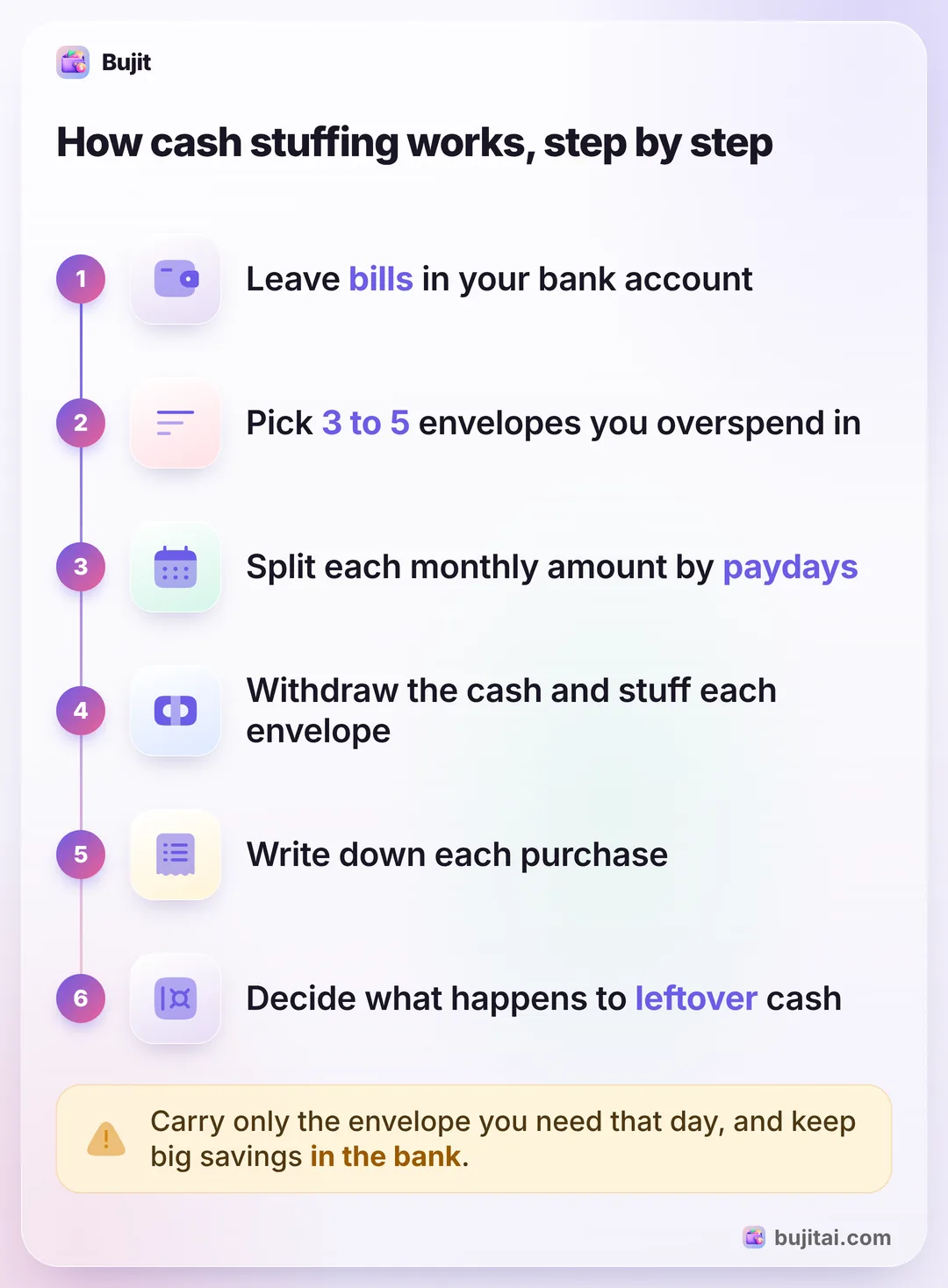
- Pick a few envelopes. Ramsey suggests starting with three to five areas where you tend to overspend, such as groceries, gas, dining out and fun money. Fidelity says the method works best for spending that changes from month to month and that you can easily pay in cash.
- Leave the bills in the bank. Rent, insurance and utilities stay in checking as automatic payments, Ramsey says. Experian adds that some of them you usually can't pay in cash anyway, such as a car payment, a credit card bill or a mortgage.
- Set a monthly amount, then split it by payday. Give each envelope an amount for the month, based on what you actually spent: Experian suggests going through your bank and card statements or tracking your spending for a few months. Then divide by how many times you're paid a month. That's how much cash goes in each payday.
- Withdraw it and stuff the envelopes. On payday, take out the total for all the envelopes in one go and split it. Label each envelope with its category and the amount that went in.
- Write down what you spend. Experian suggests writing the amount on the outside of the envelope, or keeping a running balance on an index card inside it. When you bring back change, put it in the same envelope and update the balance.
- Don't top it up. Fidelity's rule is not to borrow from another envelope or go back to the ATM until the next month comes around. If you stuff on each payday, wait for the next payday's cash. If an envelope keeps running low, change its amount when you plan the next month.
If you'd like to work out what goes where from each paycheck first, bills and savings included, splitting a paycheck before you spend it covers that step.
Cash stuffing when you're paid twice a month
Say you're paid on the 1st and the 15th, and your rent, insurance, phone and savings go out of your checking account automatically. These envelopes cover the rest, using Ramsey's $400 grocery example:
| Each month | Each payday | What comes out of it | |
|---|---|---|---|
| Groceries | $400 | $200 | Weekly shop, farmers market |
| Gas | $180 | $90 | Filling up at the pump |
| Eating out | $120 | $60 | Lunch out, coffee, a takeout night |
| Fun | $100 | $50 | Movie tickets, a night out |
| Personal | $60 | $30 | Barber or salon, drugstore runs |
That's $860 a month, or $430 in cash each payday. If you're paid every two weeks instead, most months have two paydays and usually two months a year have three. Stuff the same per-payday amounts each time, and the extra payday's cash can go straight to savings.
Savings envelopes and sinking funds
Cash stuffing isn't only for spending. Equifax suggests an envelope for saving, and does the math on a simple challenge: $10 a week for a year comes to $520. If you want to save with a little more structure, saving a little more each week of the year builds up to a bigger total.
For costs that come once or twice a year, like holiday gifts or back-to-school clothes, you can stuff a sinking fund: a twelfth of the yearly cost each month. Ramsey points out that once a fund grows to hundreds or thousands of dollars, it may make more sense to keep it in your bank account and track it there. Fidelity has a middle way: keep a savings envelope where you write down the amount, and each month move that amount into an account that earns interest.
What's left in the spending envelopes at the end of the month is your call. Fidelity suggests putting it into savings. Keeping it in the envelope also works, as long as you stuff less next time.
The risks of cash stuffing
- Lost or stolen cash is gone. Experian warns that carrying a lot of cash or keeping large sums at home could make you vulnerable to theft, and if you lose it, it's likely gone for good. Equifax suggests leaving most envelopes at home and taking only the one you need.
- Cash earns nothing. Money in an envelope earns no interest and, unlike a card, no rewards or purchase protection.
- It doesn't work online. Experian notes that cash only works for in-person purchases, and some businesses only take cards. Ramsey's answer is to keep the money for online purchases in checking and track it in your budget.
- Cash can make you spend more. Fidelity says some people find that having cash makes them want to spend it. Watch the first month closely.
- It takes time. Envelopes don't update themselves the way a bank account does, so every balance is counted and written by hand, and there are no spending alerts.
Experian compares it to a financial crash diet: you can use cash stuffing for a short time to get your spending under control, then switch to a different budgeting method.
What the envelopes don't tell you
A grocery envelope with $35 left on the 20th, five days after you stuffed $200 into it, tells you to slow down. It doesn't tell you whether the $165 went on one big shop or many small trips, unless you wrote each purchase down. And your card and online spending sits outside the envelopes, so the month has two totals: what left the envelopes and what left your account. Equifax suggests a notebook or spreadsheet for every purchase if you want to reuse your envelopes from one month to the next.
| Writing on the envelope | Notebook or spreadsheet | Bank app | Bujit | |
|---|---|---|---|---|
| Shows what's left in each envelope | If you keep the tally | With a running total | Spent of each limit, with a bar | |
| Shows where the cash went | If you write each purchase | Only the ATM withdrawal | ||
| Includes card and online spending | If you add it | What you add, plus Apple Pay taps via Shortcuts | ||
| Adds it up for you | In a spreadsheet | |||
| Needs a bank login | No | No | Yes | No |
How to keep the cash stuffing tally in Bujit
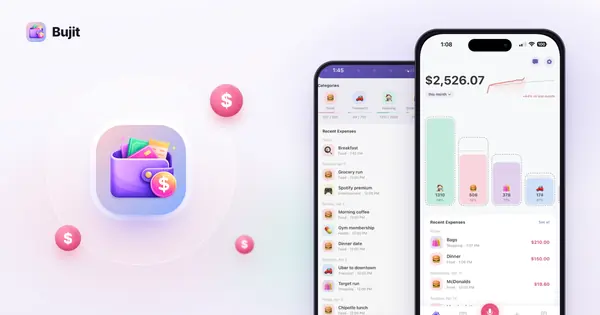
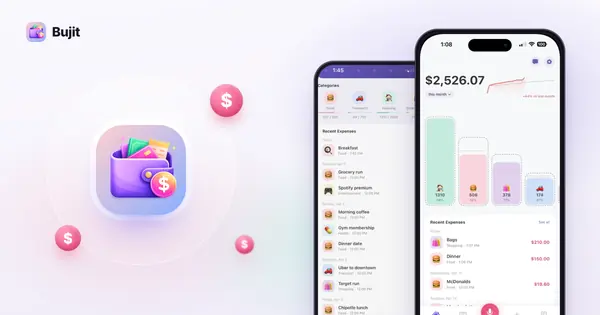
Bujit, the expense tracker we make, doesn't hold or count your cash, and it has no bank login and no account. What it can do is keep the tally: each envelope becomes a category budget, and every cash purchase you log counts against it.
In Bujit
Get Bujit- Make each envelope a category budget. Open Budgets, tap Set a budget under a category, enter the envelope's monthly Amount and tap Save. Groceries fits Food, gas fits Transport and fun fits Entertainment. Bujit's budgets run by calendar month, so enter the monthly amount, not the payday one.
- Add an envelope Bujit doesn't have. Eating out needs its own category so it doesn't mix with groceries: tap the gear on Home, then Categories, then +, and set its budget the same way.
- Log each cash purchase when you pay. Tap + at the top right, then Manual Entry. Enter the amount, type what it was with the word "cash", such as "cash, farmers market", pick the category and tap Save. Typing "cash" in the search bar in History later lists the month's cash purchases, with their total.
- Don't log the withdrawal too. The $430 you take out on payday isn't spending yet, just money moving into your envelopes. Log it as well as the purchases and the same money counts twice. Here's more on keeping each cash purchase on record.
- Get a warning as the month's money runs low. Drag Notify me at on a category's card to the percentage you want, such as 80%. A banner tells you when an expense you add in the app reaches it. The limit covers the whole month, so if you're paid twice a month, 50% means the first payday's cash should be gone.
- Check at the end of the month. Open Budgets to see how much of each limit is spent. Budgets start again on the 1st and leftover money doesn't carry over, so whatever you do with the cash that's left, each category starts the month from its full amount.
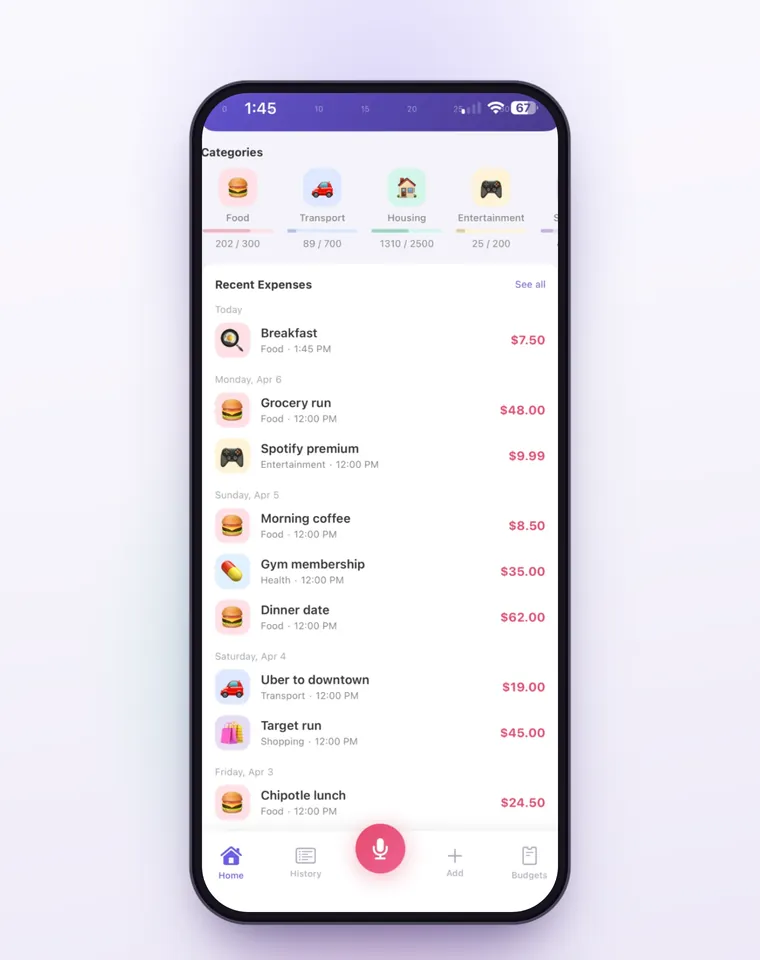
Card and online spending can go in the same way, so the month has one total. On iPhone, a Shortcuts automation can log each Apple Pay purchase when you tap your iPhone to pay; it sorts them into Bujit's six built-in categories and doesn't show the budget banner when you pay. Card purchases count against the same budgets as your envelopes. If one lands in an envelope's category, such as Food, but wasn't paid from that envelope, move it to another category so the bar still matches the cash. Voice entry and receipt scanning are part of Bujit Pro; they send what they need to Google Gemini, and only after you agree. Your expenses are stored on your phone.
Which should you use?
- You overspend in one or two categories and want a hard stop: cash stuffing, for those envelopes only.
- You pay for almost everything by card or online: envelope limits in an app, because cash can't follow you to checkout online.
- You're saving up for something big: a savings account you track, not an envelope at home.
- You use cash and cards and want one total: log the cash purchases in an expense app like Bujit, with each envelope as a category budget.
Run it for a few paydays before you judge it: by then you'll know which envelopes run dry first and whether carrying cash suits you.
Questions people ask
What is cash stuffing?
A way to budget where you put physical cash into envelopes, one for each kind of spending, and spend only what's in each envelope. Ramsey Solutions calls it the envelope system with a trendier name. Experian says it took off on social media because it's so easy to show in videos.
Is cash stuffing the same as envelope budgeting?
It's the same idea. Cash stuffing is the version with real bills in envelopes, binders or a wallet with compartments. Envelope budgeting can also be done on your phone, where each category gets a limit instead of an envelope.
How much cash should I put in each envelope?
Set a monthly amount for each category, then divide it by the number of paychecks you get in a month. Ramsey's example: $400 a month for groceries, paid twice a month, means $200 into the grocery envelope each payday. Base the amounts on what you really spent in the last few months.
What do I do with the cash left over at the end of the month?
Fidelity suggests putting it into savings. You can also leave it in the envelope for next month, which lowers how much you need to stuff. Decide before the month starts, so leftover cash doesn't turn into spending money.
Is cash stuffing safe?
It carries a real risk. Experian warns that carrying a lot of cash or keeping large sums at home could make you vulnerable to theft, and lost cash is likely gone for good. Equifax suggests leaving most envelopes at home and taking only the one you need. Ramsey suggests keeping larger sinking funds in your bank account instead of stuffing hundreds of dollars into an envelope.
How do bills and online purchases work with cash stuffing?
They stay out of the envelopes. Ramsey says fixed bills like rent, insurance and utilities stay in checking as automatic payments, and money for online purchases stays in checking too, tracked in your budget. For bills you can only pay online, like rent or student loans, Fidelity suggests keeping a running tab in marker on an envelope for each bill, so you don't go over budget.
Can I do cash stuffing with Bujit?
Bujit doesn't hold or count cash, but it can keep the tally. Give each envelope a category budget in Budgets, then log each cash purchase with Manual Entry when you pay. Don't also log the ATM withdrawal, or the same money is counted twice.
Sources
- What Is Cash Stuffing? (Experian) (checked Nov 23, 2026)
- What is cash stuffing? (Fidelity) (checked Nov 23, 2026)
- Cash Stuffing: How It Works (Ramsey Solutions) (checked Nov 23, 2026)
- Understanding Cash Stuffing (Equifax) (checked Nov 23, 2026)