Quick answer
To budget for groceries, add up what you spent on food for home last month, then compare it with the USDA's food plans for your household: two adults on its moderate plan come to about $808 a month. Pick a monthly number, divide it by 4.33 for a weekly one, and check what's left each week.
- Benchmark
- USDA food plans, monthly
- One adult, moderate plan
- About $404 to $478 a month
- Two adults, moderate plan
- About $808 a month
- Check it
- Once a week
On this page
How to budget for groceries, step by step
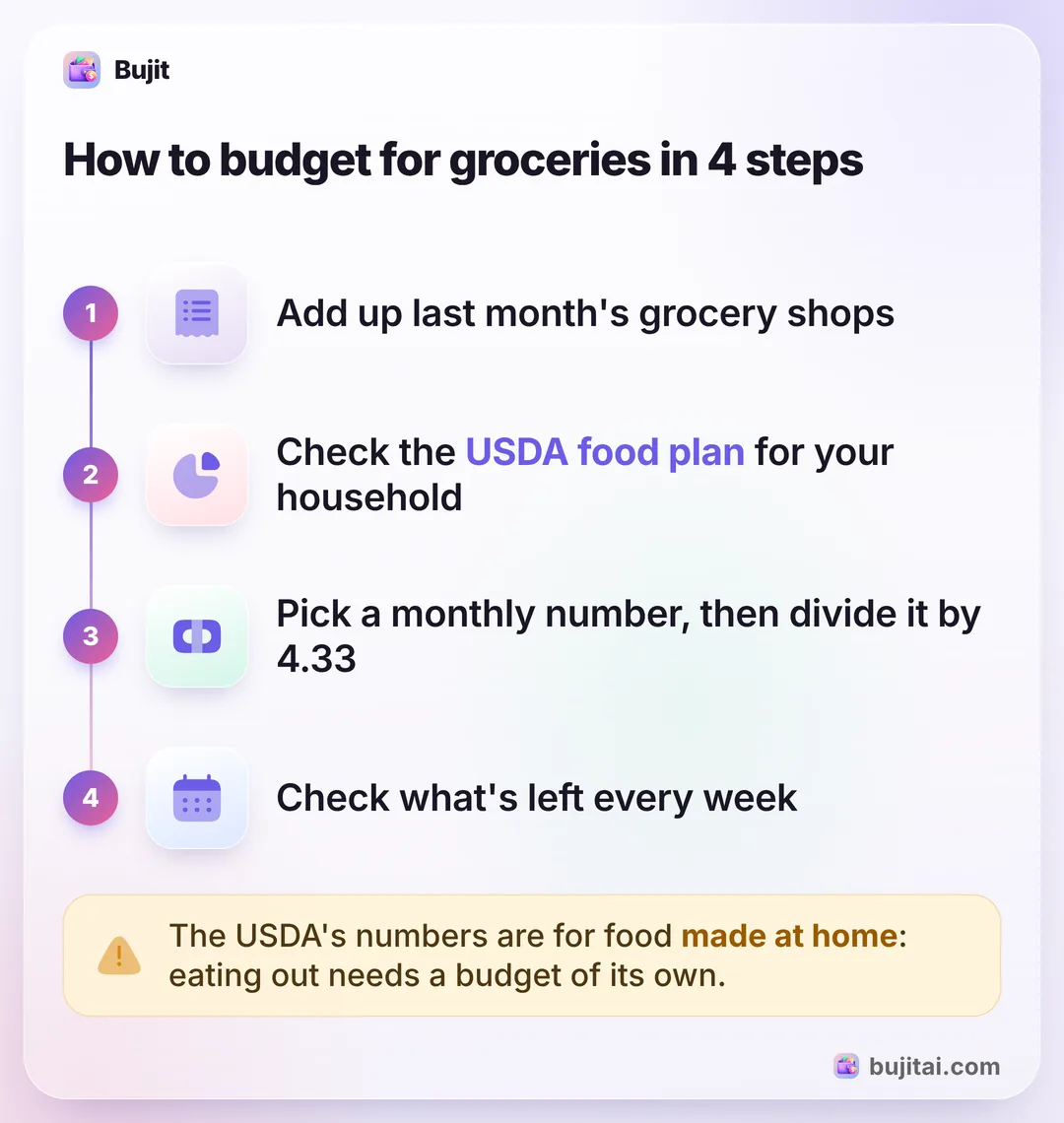
Learning how to budget for groceries takes two numbers: what you spend now, and what a household like yours spends on the USDA's food plans. Pick your budget between them, then keep an eye on it every week.
- Find what you spend now. Add up last month's grocery shops from your card statements, your bank app and your receipts. Count food and drink for home only; leave out takeout, restaurants and the coffee on the way to work.
- Look up the USDA benchmark for your household. Find each person's monthly cost on the plan closest to how you shop, add them up, then adjust for the size of your household (see below).
- Pick your number, then make it weekly. If last month was under the benchmark, keep last month's number. If it was over, aim for halfway between the two this month, then adjust next month. Divide the monthly number by 4.33, so you know what each week's shops can come to.
- Track every shop and check once a week. Compare what's left with the weeks left. A big stock-up week is fine if the next one is lighter, and keeping a budget on track after a bad week works the same way for every category.
If you don't know last month's total, start tracking now and use the USDA number for the first month. Tracking what you spend has the habit itself, step by step.
How much should you spend on groceries? The USDA numbers
Every month the USDA works out what it costs to eat healthy meals at home on four food plans: thrifty, low-cost, moderate and liberal. Its figures are per person and assume a household of four, so a household of one adds 20%, two add 10% and three add 5%; five or six take off 5%, and seven or more take off 10%.
| Thrifty | Low-cost | Moderate | Liberal | |
|---|---|---|---|---|
| A woman living alone | $305 | $332 | $404 | $516 |
| A man living alone | $383 | $381 | $478 | $584 |
| A couple | $630 | $653 | $808 | $1,008 |
| Family of four, two children 6 to 11 | $1,024 | $1,127 | $1,389 | $1,682 |
The family of four is the USDA's own reference family: a man and a woman aged 20 to 50, with children aged 6 to 8 and 9 to 11. Older adults, teenagers and younger children each have their own figures in the USDA's tables, so for any other household add up each person's cost before you adjust for its size. The thrifty plan was rebuilt in 2021 and the other three still rest on the 2007 food plans, so the plans don't line up exactly: a man's thrifty cost comes out a little above his low-cost one.
What the benchmark doesn't tell you
The USDA's tables are a fair starting point, and they stop there:
- They're a U.S. average. Prices where you live can be well above or below them.
- They're food for home only. Every meal and snack is assumed to be made at home, so eating out isn't in them.
- Food only. Toilet paper, cleaning things and other items from the same shop aren't counted. Decide whether they go in your grocery budget or somewhere else, and stick to it.
- They don't know your month. A number on paper doesn't tell you you've spent 70% of it by the 12th.
| Envelope of cash | Spreadsheet | Bank app | Bujit | |
|---|---|---|---|---|
| Shows what's left mid-month | If you keep it up | Card spending only | ||
| Cash and cards in one place | Cash only | |||
| Adds it up for you | ||||
| Tells you when you're close | When it's empty | Some do | In the app, as you log | |
| Needs a bank login | No | No | Yes | No |
How to budget for groceries in Bujit
Bujit, the expense tracker we make, keeps each shop in your month with its category, and Budgets shows how much of each category's budget is spent.
In Bujit
Get Bujit- Find last month's number. Open History, choose Last Month and tap the Food filter. To see only grocery shops, type a word you use for them, such as "grocer", in the search box: Bujit shows how many expenses match and their total.
- Set the budget. Open Budgets, tap Food, enter your monthly number and tap Save. Food covers eating out too. For groceries on their own, add a Groceries category first in Settings, then Categories, and pick it when you log a shop.
- Choose when to hear about it. On the budget, drag Notify me at to the share you want to know about, such as 80%.
- Log each shop when you pay. Tap +, then Manual Entry, say it out loud, or scan the receipt. On iPhone, a Shortcuts automation can log each Apple Pay purchase you tap your iPhone to pay for.
- Check it every week. Budgets shows what you've spent against the budget, says Approaching limit as you get close and shows how much you're over once you pass it.
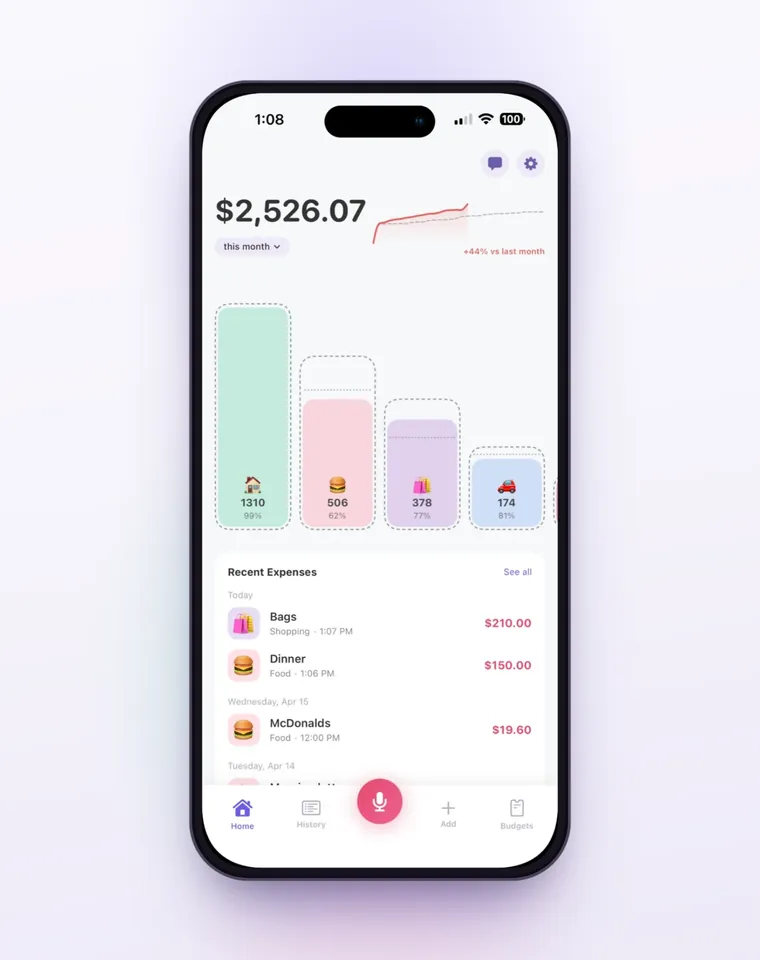
The Notify me at alert is a banner inside Bujit when you log an expense there that crosses the line. Apple Pay purchases logged by the automation count toward the budget without showing the banner, and they're sorted into a category from the merchant's name on your phone, so check that your grocery shops land in the right one. Voice entry and receipt scanning are part of Bujit Pro, and they send what they need to Google Gemini, only after you agree. Your expenses are stored on your phone, with no bank login and no account. If you keep paper receipts, scanning them with your iPhone is the quickest way to get them in.
Which should you use?
- You shop with cash and like a hard stop: an envelope with the week's grocery money in it, and logging your cash spending so it still counts in the month.
- You like formulas and will sit down every week: a spreadsheet with a row for each shop.
- You want each shop counted in seconds, cash and card, with a nudge before you go over: an expense app like Bujit, with a budget for groceries.
Once the number's set, spending less at the store is the next step, and choosing your budget categories helps the rest of the month fit around it. If this is your first budget of any kind, budgeting for beginners covers the whole month, step by step.
Questions people ask
How much should I budget for groceries a month?
Start from what you spent last month, then check it against the USDA's food plans. In September 2026, its moderate plan came to about $404 a month for a woman aged 19 to 50 living alone, $478 for a man, and $808 for a couple. The thrifty and low-cost plans are lower, the liberal plan higher.
How much should a single person spend on groceries?
On the USDA's September 2026 figures for someone aged 19 to 50 (20 to 50 on the thrifty plan) living alone, from about $305 a month (a woman on the thrifty plan) to about $584 (a man on the liberal plan). Those are for food made at home, with the USDA's 20% added for a one-person household.
How much should a family of four spend on groceries?
The USDA's reference family, a man and a woman aged 20 to 50 with children aged 6 to 8 and 9 to 11, came to $1,024 a month on the thrifty plan in September 2026. On the moderate plan the same family comes to about $1,389. Your family's ages change the total, so add up each person's cost.
Should a grocery budget include eating out?
Keep them apart. The USDA's food plans assume every meal and snack is made at home, so they're a benchmark for groceries only. Give takeout and restaurants a budget of their own, so a busy week of eating out doesn't hide inside the grocery number.
Is a weekly or monthly grocery budget better?
Set it by the month and check it by the week. Most bills and paychecks run monthly, but a week is short enough to notice when you're ahead or behind. Divide the monthly number by 4.33 to get the weekly one; that's how the USDA turns its weekly costs into monthly ones.
How do I set a grocery budget in Bujit?
Open Budgets, tap Food, enter your monthly number and tap Save, then drag Notify me at to the share you want to hear about, such as 80%. Food covers eating out too; for groceries on their own, add a Groceries category in Settings, then Categories, and pick it when you log a shop.
Sources
- USDA Food Plans: Monthly Cost of Food Reports (USDA) (checked Oct 30, 2026)